Have you ever searched for something on Google, maybe a good restaurant, a recipe, or a website service, and instantly found the answer through one of the top results?
We rarely think about why those pages appear first, but behind the scenes, it’s all thanks to how SEO works. SEO is the process that makes a webpage easier to find on search engines.
It’s not just for big brands, SEO matters for anyone who wants to be seen, read, or discovered online, especially through search engines like Google.
What Is SEO and Why Is It Important for Businesses
Search Engine Optimization (SEO) is the process of optimizing a website to appear in search engine results (like Google). The goal is simple: to increase visibility so that more potential customers can find you organically, without relying on paid ads.
Think of Google as a giant library, and your website as one of the books inside it. SEO is the way to make sure your book is placed on the front shelf, where people can easily see it.
For businesses, the benefits of SEO are broad and powerful, including but not limited to:
- Building trust: People tend to trust organic results more than paid ads.
- Saving long-term marketing costs: Once optimized, your website can attract traffic continuously without ongoing ad spend.
- Attracting relevant visitors: SEO brings in people who are already looking for your product or solution.
- Providing valuable insights: It helps you understand customer behavior and needs through keyword and traffic data.
For example, imagine you run a dental clinic in Bandung.When someone types “tooth filling Bandung” on Google, SEO helps your website appear on the first page of search results.
Without paying for ads, potential patients who are actively seeking that service can find your clinic, read reviews, view pricing, and book an appointment online. That’s the power of SEO, helping you get discovered right when people need you.
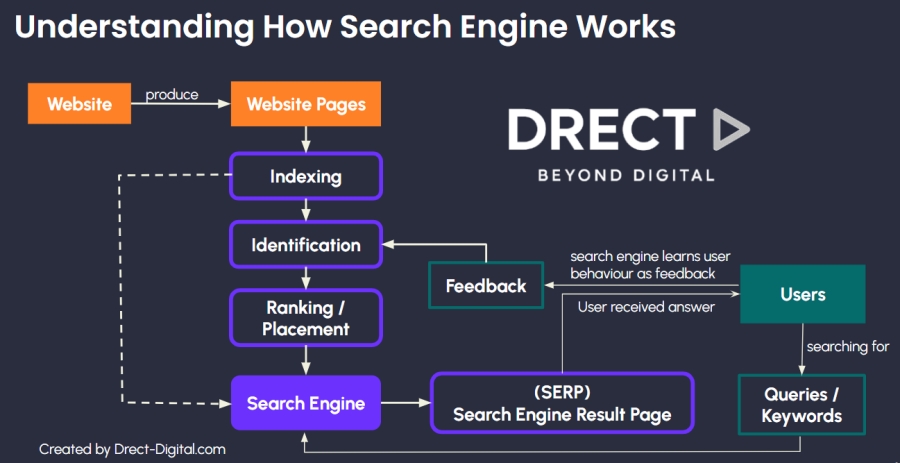
How SEO Works (in Simple Terms)
1. Website & Halaman Website – Pondasi Awal SEO
Everything starts with your website and its pages. Google can’t display what doesn’t exist, so your content and structure serve as the raw material that search engines “read.”
At this stage, Google evaluates factors like:
- Site structure: Are your pages well-connected (internal links, sitemap)?
- Content quality: Is it relevant, complete, and useful?
- User experience (UX): Is your site fast, accessible, and easy to navigate?
- Technical elements : Such as meta tags, headings (H1, H2), and descriptive URLs.
🔍 Think of Google as someone reading your book, the clearer your structure and content, the easier it is to understand your website.
2. Crawling & Indexing, Discovery and Recording Process
Once your website is live, Googlebot (Google’s crawling robot) starts exploring it. This is called crawling, where bots follow links from one page to another, like a spider exploring its web.
When your page is found, Google stores a copy in its massive database. This process is known as indexing, which means your page is now recorded and can appear in search results, though not necessarily at the top.
⚙️ If your page isn’t indexed, it’s essentially invisible to search engines, as if it doesn’t exist.
3. Identification - Understanding and Interpreting Content
After indexing, Google analyzes the content and context of your page. This involves complex algorithms designed to understand:
- The main topic of your page (e.g., “SEO strategy” or “how to build a website”).
- The key terms and related phrases used.
- The search intent, whether users want to learn, buy, or find a place.
- The relationship between pages on your site and your domain’s reputation.
Modern SEO is more about meaning than just keywords. Google now understands context and semantics, so success depends on providing clear, relevant answers, not keyword stuffing.
4. Ranking / Placement - Deciding Who Gets the Top Spot
After interpreting your page, Google decides where it ranks among other results. This is called ranking, and it’s where most SEO strategies focus.
Google uses thousands of ranking signals, including:
- Content quality: Is it accurate, detailed, and trustworthy?
- Site speed and performance.
- Domain reputation and backlinks.
- Topical authority: How deep and consistent you are in a subject.
- User signals: Reading time, bounce rate, and engagement metrics.
🎯 Google’s goal isn’t to reward the page with the “best SEO,” but to show the one that helps users the most.
5. SERP (Search Engine Results Page) - What Users Actually See
This is the final stage, what users see when they search for something. When someone enters a keyword, Google displays a mix of results on the SERP (Search Engine Results Page).
These can appear in various formats, such as:
- Organic result: Natural listings based on algorithms.
- Featured snippet / People Also Ask: Short, direct answers.
- Local pack: Maps and nearby business listings.
- Rich result: With visuals, reviews, or prices.
🧭 Your SERP position determines visibility, about 90% of all clicks happen on the first page.
6. Feedback Loop - Continuous Evaluation and Learning
The process doesn’t stop once your page ranks high. Google continuously evaluates user behavior:
- Do users still click your result?
- How long do they stay on your page?
- Do they return to Google to find another answer?
This data forms a feedback loop for the algorithm. If users seem satisfied (they stay longer or don’t search again), Google considers your content valuable and keeps it high in the rankings. If they leave quickly, your position might drop.
🔄 In other words, SEO is not just about pleasing machines, it’s about creating value for humans.
“Google only loves you when everyone else loves you first.” — Wendy Piersall
Who Needs SEO?
Almost every business can benefit from SEO, the difference lies in the purpose..
For products with digitally active customers, SEO can directly drive conversions or sales. For businesses with audiences that still interact mostly offline, SEO is still important, not necessarily to trigger immediate transactions, but to build awareness, credibility, and trust.
Because every business has its own audience and objectives, SEO strategies must be customized. The most common mistake isn’t lack of traffic, it’s a mismatch between SEO goals and business direction.

Is SEO Still Relevant?
Absolutely, SEO remains highly relevant today.
Google is still the world’s main gateway to information. According to SearchEngineLand , Google processes around 13.6 billion searches per day worldwide (2025).
Even as digital behavior shifts toward social media and AI tools, this massive number proves that people still turn to search engines when they need reliable answers, not just social feeds or chatbots.
That’s why SEO isn’t just an “optional channel.” It’s the core foundation of online visibility, a sustainable, measurable, and long-term digital asset for any brand.
The Evolution of SEO: Types and Transformations
SEO is no longer a single discipline. It has evolved to reflect changes in user behavior and search technology. Here are some major branches shaping SEO today:
Local SEO
Designed for businesses targeting local customers, such as restaurants, clinics, or retail stores. Local SEO helps your business appear in location-based results (like “coffee shop near me”), especially in Google Maps and Google Business Profile.
AEO (Answer Engine Optimization)
A step beyond traditional SEO, AEO focuses on providing direct answers to user questions. With virtual assistants and AI tools like ChatGPT or Google Gemini, search behavior has shifted from keyword-based to intent-based.
AEO ensures your content is structured and relevant enough to appear as the “best answer”, whether in featured snippets, voice searches, or AI-driven platforms.
GEO (Generative Engine Optimization)
The newest evolution in SEO for the age of AI-powered search.Unlike traditional SEO that targets search result pages (SERP), GEO focuses on making your content understandable, verifiable, and quotable by AI-driven search systems such as Google’s SGE (Search Generative Experience).
This involves creating contextual, fact-based, and semantically clear content that AI models can interpret and cite confidently.
In short, SEO today is no longer about “keyword stuffing.” It’s about understanding human behavior and machine logic, blending both to stay relevant in an increasingly competitive digital landscape.
What You Need to Start with SEO
You don’t need to be an expert to start. What matters most is having a strong foundation and clear direction. Here are the essentials to prepare before diving into optimization:
1. Website
Your website is the “home base” for all SEO activity. Make sure it is:
- Mobile-friendly, since most users now search via smartphones.
- Fast-loading, as site speed affects both ranking and user experience.
- Secure (HTTPS), because Google prioritizes safe browsing.
- Well-structured, with clear navigation and descriptive URLs to help crawlers understand your content.
2. Keyword Research
Before creating content, know what your audience is searching for. Keyword research helps you:
- Identify relevant topics tied to your product or service.
- Measure traffic potential and competition levels.
- Build a content strategy that moves users from awareness to purchase intent.
3. Quality, Relevant Content
Content is the heart of SEO, not just long or keyword-heavy, but genuinely helpful. Good content should:
- Provide useful, trustworthy information.
- Address real user needs.
- Use the right tone for your audience (not overly formal or robotic).
- Be well-structured with clear headings, visuals, and calls to action.
4. Consistency and Routine Evaluation
SEO is a marathon, not a sprint. The results take time, but with consistency, they’re sustainable.
- Conduct SEO audits every 3-6 months.
- Monitor Google algorithm updates.
- Refresh old content to keep it relevant and competitive.
SEO isn’t just about ranking on Google, it’s about helping the right people find you, at the right time, in the right way. Understanding how SEO works is the first step toward building a strong, lasting digital presence.
About DRECT Digital
DRECT DIGITAL is a digital agency dedicated to helping brands build and grow their online presence strategically. We believe that digital transformation isn’t about following trends, it’s about creating meaningful impact for businesses.
Through a data-driven approach, creative insight, and cross-industry experience, DRECT DIGITAL delivers relevant digital solutions, from strategy and web development to impactful SEO that drives real business results.